
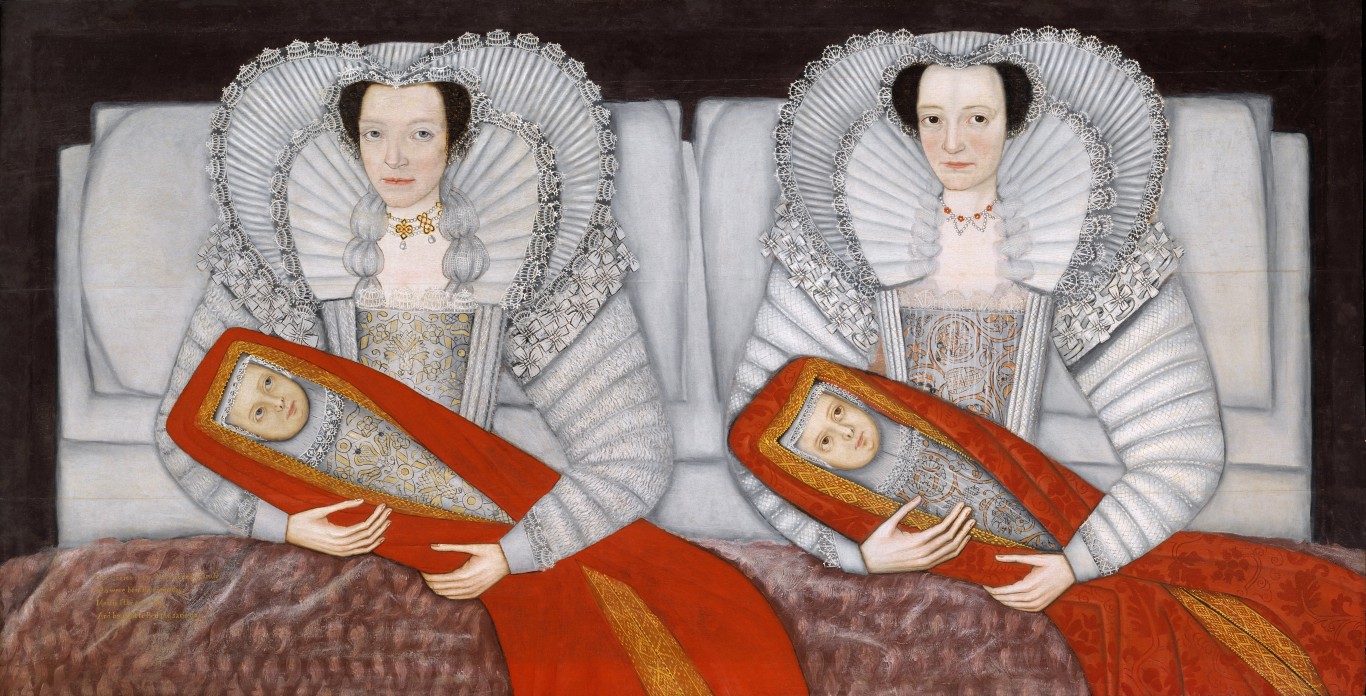
Last month in London, we strolled around Tate Britain, and I was transfixed for a while by ‘The Cholmondeley Ladies’, an oil painting on wood by an unknown artist from the beginning of the 17th century. I’d been looking differently at all the portraits from around that time, trying to find a connection with the people in them, trying to imagine where my own ancestors were then, what they were doing.
My head has been spinning since I read a blog post by James Dyke, Associate Professor in Earth Systems Science at the University of Exeter, on overshooting into dangerous climate change (the paper he mentions has now been published). James writes about the long-term consequences of going beyond 1.5°C of global warming: the cumulative damage, and how long it’s likely to take for warming to come back down, assuming, that is, that we do everything in our power to cut carbon emissions, and try other measures like carbon dioxide removal or solar geoengineering (speculative and a measure of last resort.)
The short version:
- We have already produced irreversible damage. We are never going back to a pre-industrial state.
- As we go deeper into global warming by up to 3°C or more, we can expect losses and damages to increase, but also to accumulate, future damages piled on existing damage, future climate change on existing climate change.
- Where we might have assumed the warming can come back down by the end of the century were we to do everything we needed to, this isn’t realistic. A decrease in warming is likely to take centuries, not decades.
- ‘Overshoot integrals’ represent both the increase in warming and its duration, suggesting no return to 1.5°C before around the year 2500.
I read the blog post, and my brain did a backflip. 2500 is a marker to indicate how long any return to present conditions could take. It’s illustrative. But what is known is that going over 1.5°C is now certain, 2°C is likely, and more is entirely possible. And those temperature rises could be maintained for hundreds of years.
Permanent damage. Accumulating damage. Hundreds of years.
2500 is 474 years in the future. I tried to imagine what life might look like then. I searched for fiction set around that year. Waterworld and Idiocracy came up. In Waterworld, Kevin Costner plays a webbed-footed drifter searching for dry land on an Earth flooded by melted ice caps. In Idiocracy, Luke Wilson plays an average man chosen for a top-secret government hibernation experiment, who wakes five hundred years later in a dystopia where anti-intellectualism has taken over America and everyone is a moron. I’ll pause there to let you compose your own joke.
Then I traced 474 years back. In 1552, Walter Raleigh was born, the Peace of Passau granted religious freedoms to Protestant princes in the Holy Roman Empire, and Ivan the Terrible conquered the Khanate of Kazan. At the Tate, I was seeing the faces of people from the late 16th and early 17th centuries and trying to imagine what was in their heads, and how they might have pictured 2026. I got nowhere. They lived in a different world. I doubt they thought much about us.
The world of 2500 will be at least as unrecognisable to us as the world Raleigh was born into. I don’t even know what people in 2500 will take as a baseline. Do they compare to the pre-industrial world, or is it a historical footnote?
The British Antarctic Survey recently announced that Thwaites Glacier, a remote glacier the size of Britain, is set to continue losing ice even if the oceans cool. Thwaites is likely to be lost, and could trigger a cascade effect in surrounding glaciers leading to a 3+ meter sea level rise, changing the coastline of the entire planet and displacing hundreds of millions, billions, of people.
I struggle to process what could happen over the next few hundred years. I feel solastalgia, ecological grief and disorientation at the timescales involved and the scale of the damage. I can’t connect any return to normal back to where we are now over such a length of time, because there is no way. Overshoot isn’t elastic; we don’t ping back. There will be permanent loss, and the world will not be the same.
Thinking hundreds of years ahead feels like being slapped with the realisation of what is already happening in front of our eyes. I picture the damage that has started, see a world I don’t recognise, stare across a chasm at a different place, and wonder how people are supposed to live there.
The question I keep returning to is what we owe the people of 2500, nineteen generations from now, and what we can actually do for them. Some ideas from my study and reading came to mind when I started thinking about the timescales James wrote about.
Kelly Levin and co-authors write about ‘super wicked problems‘, building on work by Rittel and Webber from 1973 in creating the term ‘wicked problems’ to describe complex problems that that lack simplistic or straightforward responses. Super wicked problems have four defining features. Time is running out. The people causing the problem are also the ones trying to solve it. There is no strong central authority able to act, or it is too weak. And because we irrationally undervalue the future, the action we need keeps being kicked down the road. Levin and co-authors describe the tragedy of institutions and policies that respond only to short-term horizons, even when the evidence overwhelmingly says they must act now for the long term.
You can see it happening. The full content of the government’s national security assessment on global ecosystems remains redacted. It warns of severe, cascading threats, from mass migration and food system failure to war and massive drops in GDP. Meanwhile we are told to stock up on three days’ worth of food and offered cheaper gherkins.
I’m not the only one feeling overwhelmed. Our government almost certainly knows more than it is telling us, and probably doesn’t know how to process it either. It may not dare, or be able, to make the changes we need as quickly and aggressively as we need them. Those changes have to be made together, internationally, while the international order is turning itself inside out, our society is polarised, and some of the most resource-rich people on the planet think moving to Mars or becoming cybernetically enhanced is a more attractive option than preserving a liveable home on Earth.
Levin and co-authors suggest that we need to overcome the tragedy of the super wicked problem of climate change by constraining our future selves through entrenching policies that ratchet up positive behaviours over time. I think to the year 2500 and wonder if they want to have been constrained, what technical abilities they will have, what we’ve left them, and that the main constraints we are setting for future us are the species and habitats that no longer exist, the options no longer available, the knowledge lost. I doubt the people of 2500 care about our paternalism as much as they do what we leave them that they can use, and what options we leave open to them.
Dougald Hine says that the world is deep in trouble, deeper than we know how to talk about, which captures my feelings well. In his book At Work In The Ruins he suggests we should mourn what we lose, jettison what we don’t need, and “leave good ruins” – clues and starting points for those that come after us. Good ruins need to be usable, tell them something, maybe preserve the best things we can, assuming that what we leave is worth preserving. But it’s an apocalyptic view that suggests there is nothing left of us for future generations to find but ruins, when there is a thread that runs between now and then, as far ahead as it is.
The seventh-generation principle, attributed to the Great Law of Haudenosaunee Confederacy, says we should make decisions with our descendants seven generations ahead in mind. The year 2500 is nineteen generations away, so the principle might seem to break. A 2025 survey asking Americans how many generations ahead they should consider in collective decisions only got as far as ten, though some moral concern extended to 30.
But the principle was never a fixed horizon. It’s a rolling window. Each generation looks behind, thinks ahead, and the obligation passes on like a relay. What stops the relay breaking is a continuous community with a collective memory that carries obligations from one generation to the next. Place and culture play their part.
What has changed, apart from the severity of the problems we face, is the scale. Some of what we’re dealing with runs on timescales the seventh-generation principle never contemplated: long-lived CO2, ice sheets set to erode over centuries, radioactive waste that stays hazardous for tens of thousands of years, and the overshoot integral.
A rolling window of felt kinship isn’t enough for these. We need formal, deliberately designed institutions, such as trusts, constitutional protections or guardian bodies, to do the remembering. They would need to be resistant to time-discounting and to fading concern for generations we feel no connection with.
Finland’s deep underground nuclear waste facility, designed to last 100,000 years, is one example. The Long Now Foundation might call it the work of good ancestors. In the spirit of the seventh-generation principle, the Foundation promotes long-term thinking that looks forwards and back 10,000 years, the length of our civilisation since the glaciers retreated and agriculture developed.
A few things come out of this all for me.
- We can’t protect them, but we can keep their options open. We can be morally concerned for the people of 2500, but we can’t protect them directly. We can protect ourselves and hope that leaves more for them. We’re far more likely to act in our own immediate self-interest anyway. We can’t dictate their lives. We can leave them as full a toolbox as possible and a liveable baseline.
- We can’t assume they’ll cope. The people of 2500 are likely to have survived war, mass migration, warming of 2°C and more, and the failure of multiple states, if not the weakening of the fabric of our civilisation. Assuming they’ll cope is another kind of time-discounting, and it lets us off taking responsibility. My ecological grief is a luxury and does nothing for them. My choices, our choices, might.
- Leave good ruins, but tidy first. Hine’s idea shifts the emphasis from fixing things for the future to bequeathing something that works. We can still preserve a great deal that works, but we need to do some döstädning, Swedish death cleaning, and leave only the useful things. Jettisoning the junk would be better for us too, and might be part of starting to fix things.
- We need to expect distasteful choices as well as hope for better for ourselves now. Whatever we do to cut emissions, draw down carbon and feed ourselves will include pragmatic or unavoidable choices that many people will dislike, as well as making things better for us, now. For food systems, that might mean continuing to embrace the industrial, as well as working for more localised food systems. Difficult and unpopular compromises could be balanced with real improvements, the kind of things that make life better, even if the worst doesn’t happen.
- Protect what makes a future worth living in. Whatever technological measures we take to preserve a liveable future, it isn’t worth living without the community, connections, culture and stories we share. We need to protect these now from enshittifying social media, a fragmented and vulnerable web, and pollution by AI. It feels more important than ever to share our stories and culture face to face, away from digital tools controlled by companies that don’t have our interests at heart.
Food is one of the best ways I can think of to share our culture, preserve what is good, and hold on to our sense of place and meaning through whatever comes next. Our food systems are central to the fixes we need to make and the resilience we need to build, and how we eat is central to preserving what matters. Foods from a place, religious and cultural foods, local food systems, food sovereignty and citizenship, and meals shared around a table are how we make it through, and how we make it worth it. It would be exciting to think that was one thing that we preserved for people in 2500. If all I had was food in pill form, what would be the point.
When H and I married in 2012, one of the poems read at our wedding was Roger McGough’s Vow. The central verse comes to mind if I feel overwhelmed by thinking about climate overshoot.
I vow to bear in mind that if, at times
Roger McGough
Things seem to go from bad to worse,
They also go from bad to better.
The lost purse is handed in, the letter
Contains wonderful news. Trains run on time,
Hurricanes run out of breath, floods subside,
And toast lands jam-side up.


