

…results suggest that people do flit from one task to another more frequently than they did in previous decades, and that this switching is often detrimental to performance. But there is little evidence that the brain’s fundamental ability to concentrate has been impaired. This suggests that if we can shut down the distractions of our environment, it is possible to recover focus.
David Adam, Are attention spans really shrinking? What the science says – Nature 653, 20-22 (2026)
Naturally I read this article, and wrote this blog post, when I should have been doing something else.
The article immediately drew my attention because I had the same question – are our attention spans shrinking? Are we becoming a society of scatterbrains constantly pulled from the task at hand by notifications, vibrations, beeps, or our own heads? Can we blame social media? Was that a squirrel just then?
David Adam suggests that no, our attention spans aren’t shrinking – but there’s more competition for them.
I’ve had questions about my attentiveness for some time. My Master’s degree studies forced them into the open last year when I had to approach student welfare services for support as I’d left work undone while a deadline loomed. I started my Master’s fully expecting that I would feel some discomfort with deadlines and focus, and last year I felt the pinch after having been vigilant about keeping on top of deadlines. My attention was everywhere and nowhere despite knowing the deadline was coming.
I spoke to a mental health worker through my local surgery, skirted around the possibility that I might have symptoms of Attention Deficit Disorder. I haven’t sought a diagnosis, and I doubt I will. I feel like a fraud, getting diagnosed as an adult takes a long time, I don’t know how it would necessarily help me, meanwhile I just need to find ways to manage my thought balloons.
Because my attentiveness has been an issue since way before social media. The thought balloons thing is something a teacher said about me in primary school.
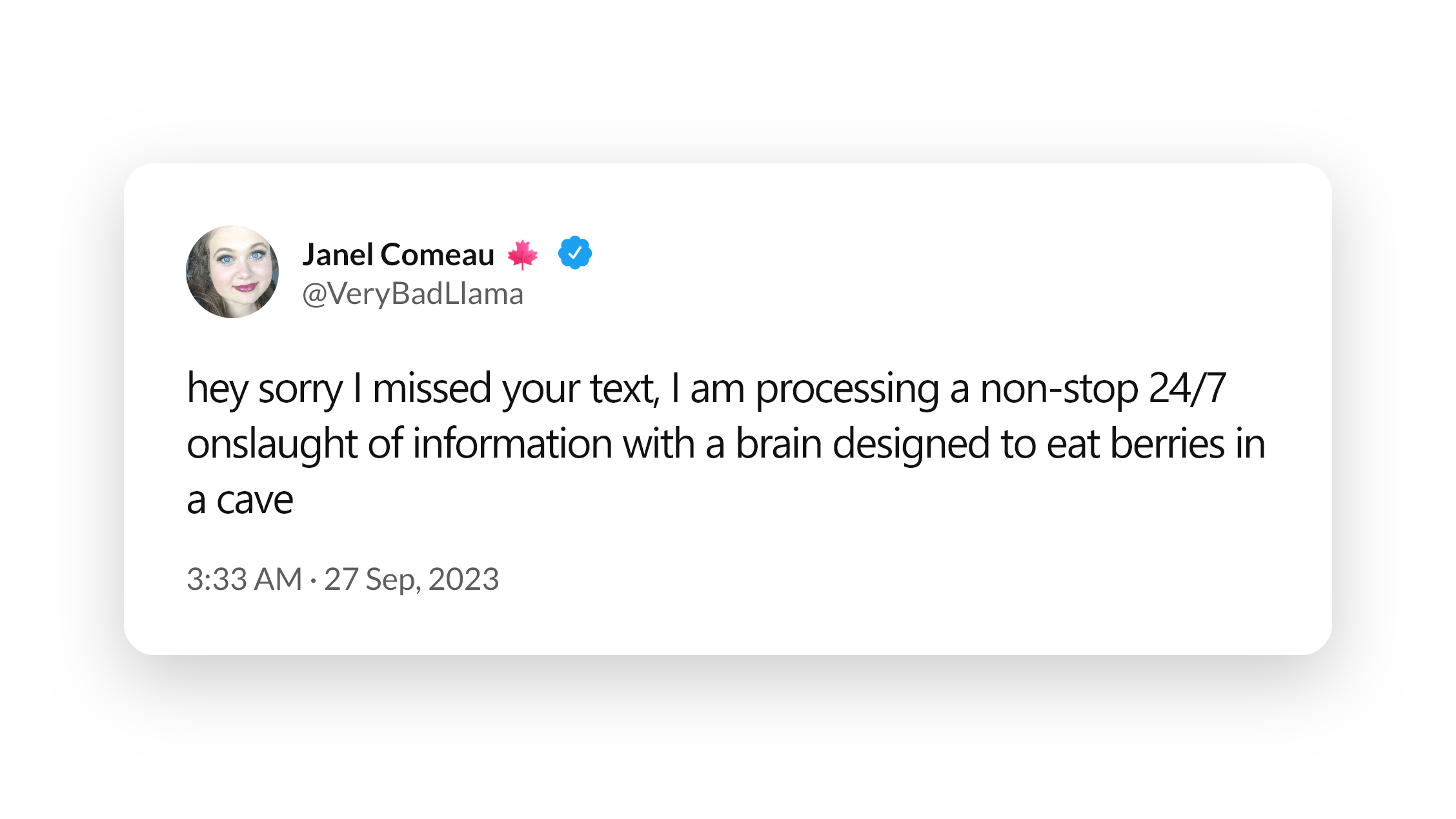
Social media, my phone, the news (particularly the ongoing polycrisis and geopolitical shitshow we’re living through) have probably made things worse, but I couldn’t blame them in primary school. I’ve had to accept that this is simply how my mind works; it’s who I am, and yes, there is also a lot of background noise. I’m interested in a lot of things, and my mind wants to switch around and make connections back and forth. I long for periods of deep focus where I can bury myself in a piece of work, and when they come they’re immensely satisfying, like gorging on a feast.
It has been miserable at times to have a brain that won’t sit still, but (and I often need to remind myself of this) the only person generally giving me grief is me, so I get a lot further by easing up on myself.
So I manage my balloons with a varying regimen of
- Drum and bass – when the music is busy and fast it seems to take the fizz off my brain by giving it something to cancel out the noise.
- Exercise – either a walk or run beforehand, or putting work aside and doing something physical, which also resets the whole sitting-at-my-desk-torturing-myself-for-not-getting-anywhere thing.
- Coffee – strong coffee often feels like riding the high to get work done, and appears to be a tool for self-medication for people with bouncy minds.
- Prioritisation – some of the pressure and distraction comes from the mistake of putting everything in the to-do list at once. Simply reviewing things and putting them in a box called “deal with this next week, not now” is a huge help. To-do lists stop working when due dates pass and jobs back up, so I stopped setting them. Tasks are now tagged #ASAP, #ThisWeek, or #ThisMonth, with a hard date only when it’s genuinely a drop-dead deadline.
- Watching out for the context switch – as the article says, switching tasks is a real threat to attention, which is where prioritisation comes back in. That request that just came in has to wait its turn.
- Refocus when I need to – if my mind is pulling in a particular direction persistently enough, I won’t fight it; I’ll get behind it and do that thing. Once it’s done and out of the way, I can return to what I was working on. I have to acknowledge that I might not always be the best person to set my own priorities, and go where the energy takes me.
It might sound clichéd, but so much of managing my attention comes down to two things: accepting that this is how I am, and recognising that the way my mind works is a superpower, not a flaw. The tension and discomfort of inattentiveness comes from the gap between what I expected to achieve and what I actually achieve, much like the way happiness is described as the difference between expectation and reality.
But Instagram Reels are the devil.
Thanks Steph for the link to this wonderful thing by Terry Godier about the endless demands placed on us by our tech.


